October 24, 2010 - 15:38
DNA, this unknown
Since 1953, when Watson and Crick published the three-dimensional structure of the double helix of DNA , were made large progress in the field of genetics. These advances have led, over the past 60 years, amazing new knowledge, from the definition of catalytic RNA in the 80s until the completion of the Human Genome Project a few years ago. Despite these great strides, and despite a genome sequencing now has become almost routine in some laboratories, the sequencing of genomes has taught us an important lesson: even complete knowledge of the nucleotide sequence is only the first step in discovering the functions of DNA, a molecule that seems to always reserve new surprises to scientists involved in genetic engineering. The post-genome was
The difference between the human genome sequence and the monkey is extremely low. This brings out an important question: what makes it different species so similar to the sequence of the DNA ? While in the past it was believed that sequencing the genome of an organism could understand all biological processes, today we know that the protein expression patterns of two cells with similar genomic content can be very different and its diversity can not be fully understood observing only the sequence of DNA . That is why, for some years, has led to a major new discipline called proteomics . The proteomics aims to study the so-called proteome, ie the set of proteins expressed in cells at a given time or in the context of certain processes. The aim is also to characterize the regulatory mechanisms that lead from the same genome, the definition of frameworks are very different protein expression in different tissues or at different times of development. Think of the caterpillar and the butterfly: the same body and same DNA, but very different phenotype.

New levels of gene regulation
These mechanisms of regulation of gene expression are yet to be discovered. If in fact we already know a lot about the transcriptional regulation based on the interaction of transcription factors with specific sequences upstream or downstream of genes, there is still much to discover when you look at other levels which may act on the regulation of gene. For example, the synthesis of a protein can be regulated at translational level by acting on the block or on the degradation of its mRNA. A strategy of this type makes use of so-called antisense RNA. They are polynucleotide molecules that can bind to complementary mRNA, thus preventing so the translation by the ribosome. The microRNA
are another type of RNA regulators. They are able to recognize complementary mRNA sequence and prevent translation, guiding them towards degradation. Although microRNA are known for some time and are also used for experimental purposes for gene silencing, recently a new discovery has made the picture even more complex. Scientists at the Medical Center of Boston, in fact, they found that the role of microRNA and mRNA can be reversed: RNA transcribed but non-coding, can bind to microRNA that they can operate by preventing gene silencing, thus adding another point to the list of possible regulatory mechanisms.
are another type of RNA regulators. They are able to recognize complementary mRNA sequence and prevent translation, guiding them towards degradation. Although microRNA are known for some time and are also used for experimental purposes for gene silencing, recently a new discovery has made the picture even more complex. Scientists at the Medical Center of Boston, in fact, they found that the role of microRNA and mRNA can be reversed: RNA transcribed but non-coding, can bind to microRNA that they can operate by preventing gene silencing, thus adding another point to the list of possible regulatory mechanisms.
The revenge of the junk DNA
The discovery of these new molecules nucleotide involved in gene regulation has helped to assign a function to at least part of that portion of the genome non-coding proteins, which in past years had been labeled with the name of junk DNA, ie DNA garbage. For much has been discussed on the possible function of this large portion of the genome. For many it was considered nothing more than DNA "selfish" that, like a parasite, had accumulated in the genomes while not performing any active function, but passing on from generation to generation along with the DNA coding. Other assumptions of the junk DNA a function of "buffer" for mutations. It was thought that the fact that the genes were diluted in the midst of a lot of useless DNA contribute to lower the probability that a deleterious mutation fell within a gene. Today
DNA for which you do not know a function is becoming less abundant. Increasingly psuedogeni and non-coding RNA sequences are recognized as responsible for gene regulation while not synthesizing proteins, thereby expanding the functional portion of the genome considered.
DNA for which you do not know a function is becoming less abundant. Increasingly psuedogeni and non-coding RNA sequences are recognized as responsible for gene regulation while not synthesizing proteins, thereby expanding the functional portion of the genome considered.
New Frontiers: DNA quantum
A branch to say the least futuristic of biology is the so-called quantum biology , Or "quantum biology." It aims to study the implications of the phenomena described by quantum physics in biological systems. Its not often you hear about this type of study, but the results are there and probably will help us in the future to better understand the biochemical processes and life itself.
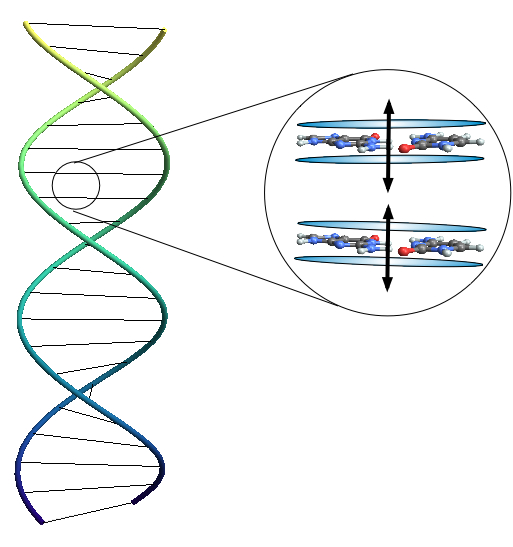
A very peculiar phenomenon of the quantum world is the so-called entanglement . Two particles in a state of entanglement are able, at least ostensibly, to provide each other information on its quantum state in a non-local, which for decades haunted the mind physicists. According to a study by Elisabeth Rieper the National University of Singapore on the phenomenon of ' quantum entanglement would have a key role in structuring the DNA, saying that even according to classical structural model of the molecule DNA would not have enough energy to remain united.
A very peculiar phenomenon of the quantum world is the so-called entanglement . Two particles in a state of entanglement are able, at least ostensibly, to provide each other information on its quantum state in a non-local, which for decades haunted the mind physicists. According to a study by Elisabeth Rieper the National University of Singapore on the phenomenon of ' quantum entanglement would have a key role in structuring the DNA, saying that even according to classical structural model of the molecule DNA would not have enough energy to remain united.
All these new data and findings suggest that the DNA, the molecule essential for life, still holds many secrets waiting to be discovered. Observations of the experimental data, although we provide new knowledge, often introduce new questions, making increasingly diverse and complex study of the phenomenon of life.


0 comments:
Post a Comment